
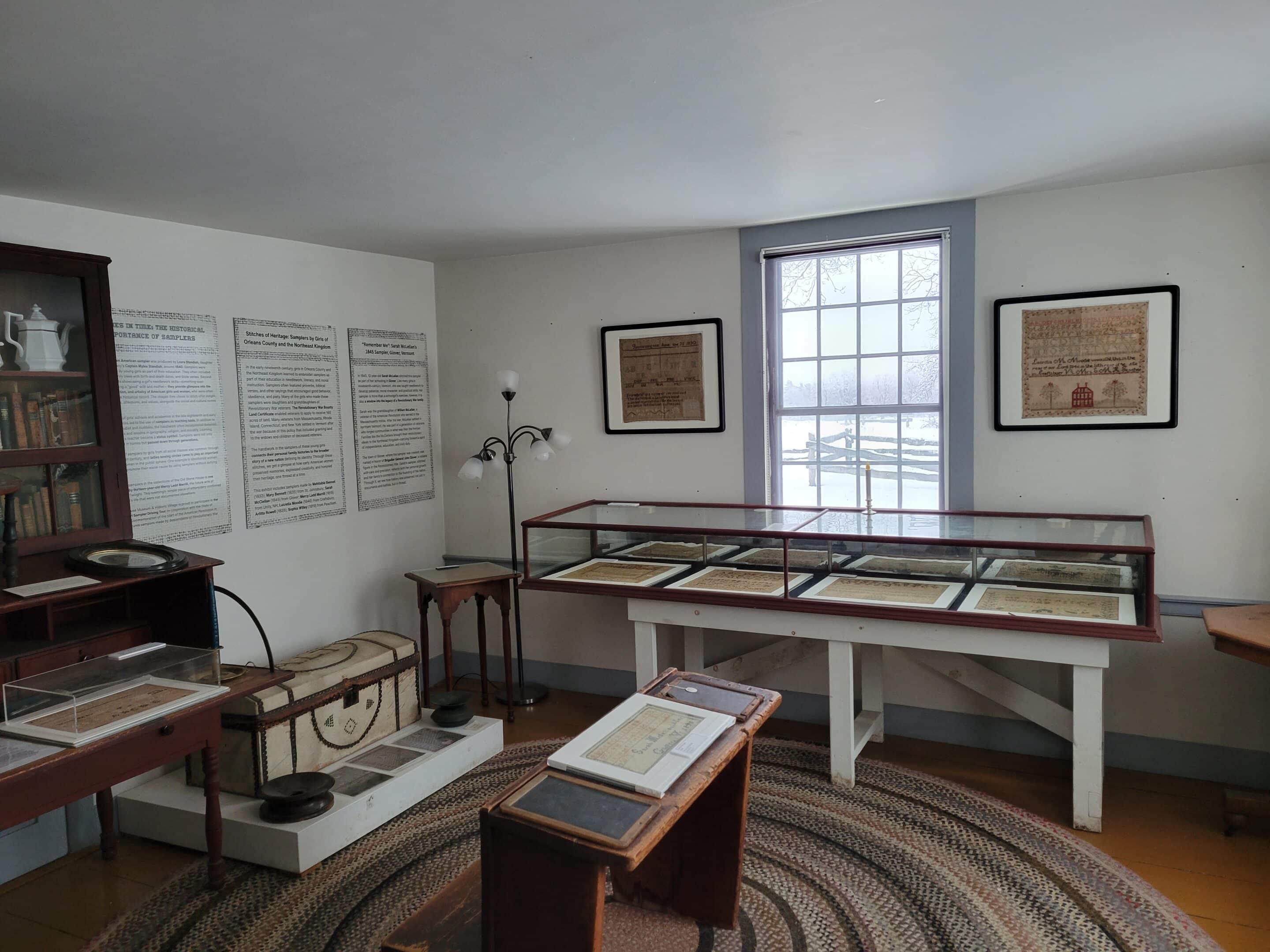
Student homework has taken many forms over the years. In the paperless classrooms of today, students learn by the light of computer monitors and tablet screens, but in the 1830s Mary and Mehitable Bennett, sisters living in St. Johnsbury, stitched their homework into fabric by the dim glow of candlelight.
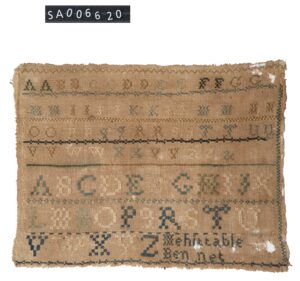
Mary and Mehitable Bennett created these samplers during the early nineteenth century. (Mary stitched her sampler in 1834, while Mehitable’s bears no date.) Used as a teaching tool, completing a sampler was a typical part of a girl’s education at the time. Samplers provided girls with an opportunity to practice their embroidery and to show their mastery of numbers and letters. In some cases the samplers included a proverb, a bible verse or saying to reinforce values and encourage culturally appropriate behavior. The samplers also served as an expression of creativity. Domestic or pastoral scenes and decorative flourishes graced many samplers.
Samplers followed a similar form and pattern across time and locations, featuring the alphabet and numbers, but more uniquely the names and often the ages of their creators. A demographic that is often overlooked in traditional history books, these young women (between the ages of 5 and 13) left historians valuable artifacts, sewing clues about their lives into the historic record.
Studying samplers offer us insights into the culture and education of young women over the last two centuries. In 2024, the Old Stone House Museum & Historic Village worked with the Vermont Sampler Initiative to host two ‘Sampler ID Days’ to document as many Vermont samplers as possible from the Orleans County area. In addition to documenting the museum’s own samplers more fully, the public was invited to bring their family heirloom samplers to the event so they could also be described and photographed to be included in state and national databases. Vermont Sampler Initiative volunteers worked with museum staff and volunteers to record information about the makers including name, location, date, and age. In addition, team members noted the measurements, colors, type of material and stitches. Any verse or saying on the samplers was also recorded. In some cases the samplers had the name of the girl’s teacher as well.
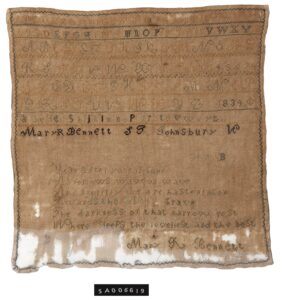
When museum staff realized two of the samplers in our collection had come originally from St. Johnsbury, in Caledonia County, rather than Orleans County, the focus of the Old Stone House Museum’s collection, staff contacted the St. Johnsbury History and Heritage Center to determine whether it would be interested in adding the samplers to its collection. The samplers were presented to the St. Johnsbury museum last month (Jan 2026). Now the nineteenth century samplers made by the Bennett sisters of St. Johnsbury are back home in the community where they originated.
The museum is constantly evaluating its collection in order to make sure it can effectively interpret the history of Orleans County and its people. When museum staff identifies something in the collection that doesn’t meet the criteria outlined in the museum’s collections policy, staff may recommend to the collections committee that the object be deaccessioned or formally removed from the museum’s collection. If the committee and then the Board of Trustees approve the deaccessioning, museum staff try to find an appropriate home for the object. As part of this ongoing effort, other objects that have been deaccessioned have been sent to local historical societies around the state, the Vermont Historical Society and several other cultural institutions in New England.
The Schoolgirl Sampler exhibit will be on display at the Twilight House through the summer of 2026.
Written by Darlene Young, Registrar
Sampler Photos courtesy of the Vermont Sampler Initiative